Sacramento Security Staffing Benchmarks 2026: Patrol Frequency, Cost & Coverage Data
PPO #1227308/20/20263684 wordssecurity patrol sacramento
Most Sacramento property owners buy security the same way: something bad happens, the phone comes out, and whoever answers first gets the contract. Six months later nobody can say whether the money is working. This report exists to replace that reflex with numbers. Below is the framework Summit Force Security Group uses when we price and design coverage across Sacramento County, Placer County, and the Solano corridor — the arithmetic behind patrol frequency, the exposure a schedule leaves open, the real cost bands per service type, and the public data sources you can verify yourself before signing anything.
Nothing here is a scare statistic. Every figure is either simple arithmetic you can reproduce on paper, a published rate band from our own service pages, or a pointer to a primary government source. Where a number depends on your site, we say so.
The one number nobody calculates: unwatched minutes
Every security program can be reduced to a single honest metric — how many minutes per night your property is unobserved. Guard hours, patrol passes, camera counts, and app dashboards are all inputs. Unwatched minutes is the output.
The math is not complicated. Take the overnight window you actually care about, subtract the time an officer is physically present, and what remains is your exposure. A "nightly patrol" that means two passes with fifteen minutes on site each is thirty minutes of presence inside a ten-hour window. That is 570 unwatched minutes, or 95% of the night.
That chart is arithmetic, not a claim about crime. But it reframes the buying question. When a competitor quotes you "nightly mobile patrol" for a few hundred dollars a month, they are not selling you coverage — they are selling you a deterrent signature: tire tracks, a logged timestamp, a visible marked unit at unpredictable hours. That is a legitimate product with a real effect on opportunistic activity, and for most commercial parcels it is the correct first purchase. It is simply not the same product as presence.
The failure mode we see repeatedly across mobile patrol accounts in Rancho Cordova and Sacramento's industrial pockets is a mismatch: a site with a genuine occupancy problem or repeat after-hours entries buys two passes a night, sees no change, and concludes "guards don't work." The service didn't fail. The specification did.
Two products, two jobs
Mobile vehicle patrol
Buys deterrent signature and documentation. Marked unit, randomized arrival windows, GPS-timestamped checkpoints, exception reporting. Best where the threat is opportunistic and the parcel is large or low-traffic.
Standing / dedicated post
Buys presence and immediate intervention. An officer physically holds the property for the contracted hours. Best where the threat is persistent, access control is required, or the liability exposure is high.
Alarm and camera response
Buys reaction time on a trigger. You pay for availability, not occupancy. Works only when the trigger is reliable and the response window is contractually defined.
Hybrid schedule
Buys targeted presence. Standing post during the highest-risk block, patrol passes on the shoulders. Nearly always the best cost-per-risk-hour on mid-sized sites.
What the public data actually supports
Security marketing is full of borrowed statistics with no traceable origin. Rather than repeat them, here are the primary sources we use, what each one is genuinely good for, and what it cannot tell you. Check them yourself — they are free, and they are the same sources an opposing attorney would use.
| Source | What it gives you | What it cannot tell you |
|---|---|---|
| FBI Crime Data Explorer | Agency-level reported offense counts and trends, including Sacramento-area agencies, by year and offense category | Anything about your parcel, time-of-day granularity, or unreported activity |
| California DOJ OpenJustice | Statewide and county crime, arrest, and clearance data with downloadable tables | Commercial-versus-residential breakdowns at the site level |
| City of Sacramento Open Data | Police service-call and report datasets you can filter to your own beat or grid | Cause, outcome, or whether security was present |
| BSIS (Bureau of Security and Investigative Services) | License verification for every PPO and guard card in California | Quality, insurance limits, or training beyond the statutory minimum |
| BLS Occupational Employment Statistics, 33-9032 | Wage floors for security guards by metro area — the real driver of your hourly rate | What a specific company charges or pays |
| Cal/OSHA and NFPA fire watch standards | Requirements that trigger a mandated fire watch when suppression systems are impaired | Whether your AHJ will accept a given staffing plan — ask them |
Two takeaways matter more than any individual number.
First, wage floors, not margin, set your price. The BLS occupational wage tables for the Sacramento–Roseville–Folsom metro define the realistic bottom of any legitimate quote. Add employer payroll taxes, workers' compensation for a guard classification, general liability, uniforms, vehicle cost for patrol work, supervision, and training hours, and the arithmetic gets tight fast. When a quote lands meaningfully below that stack, something is being skipped — usually training, supervision, insurance limits, or lawful overtime. We wrote about the mechanics of that in our pricing transparency guide for budget-conscious buyers.
Second, verification is a five-minute task and almost nobody does it. The BSIS license lookup will tell you whether a PPO number is real, current, and unencumbered. Ours is PPO #122730, registered in California as Summit Force Security Group, Private Security. Ask every bidder for their number and check it before the walkthrough, not after the incident. Our encyclopedia of California private security terms explains what each license class does and does not permit.
Cost bands by service type
These are the bands we actually quote in the Sacramento region as of 2026. They are ranges because they move with site conditions: single officer versus multi-post, armed versus unarmed, weekday versus holiday, and whether the schedule creates overtime. Use them to sanity-check any bid you receive — including ours.
| Service | Typical billing basis | Sacramento-region band | Primary cost drivers |
|---|---|---|---|
| Unarmed standing guard | Per officer hour | Mid-range hourly, higher on nights, weekends, and short shifts | Shift length, overtime exposure, post orders complexity |
| Armed standing guard | Per officer hour | Meaningful premium over unarmed | Exposed-weapon permit, insurance, qualification upkeep |
| Mobile vehicle patrol | Per pass, or per month for a pass package | Monthly package pricing scales with passes and dwell time | Number of properties on the route, pass count, dwell minutes |
| Alarm / camera response | Retainer plus per-response | Retainer with per-call charge | Contracted response window, distance from dispatch |
| Fire watch | Per officer hour, often 24-hour continuous | Continuous coverage priced at premium | Mandated log intervals, AHJ requirements, duration |
| Event security | Per officer hour with minimums | Minimum-hour blocks, higher for alcohol service and crowd control | Guest count, alcohol, venue rules, ingress complexity |
The mistake buyers make with this table is comparing hourly rates across rows. A patrol package at a low monthly number and a standing post at an hourly rate are not competing products; they are different amounts of coverage. Compare cost per unwatched minute eliminated, not cost per hour. Our security guard cost calculator does that comparison for a specific address and schedule.
That index is derived from the structure of the bands above, not from a survey — the point is the shape, not the decimals. Coverage cost is roughly linear in officer hours and roughly flat in deterrent signature. The cheapest large gain almost always comes from adding passes or shifting them to the right hours, not from jumping straight to a 24/7 post.
Sector benchmarks: what "adequate" looks like
Adequacy is site-specific, but the patterns repeat by property class. Below is how we scope each sector, and the failure mode we most often inherit from a previous vendor.
Warehouse and distribution
Gate discipline is the whole game. Most warehouse losses we are called about are not dramatic break-ins; they are unlogged vehicles, propped doors, after-hours yard access, and trailer seals nobody checked. A patrol-only spec on an active yard with third-party drivers is usually underspecified. The right benchmark is a gate log with a name, plate, seal number, and time for every movement in the unattended window — which requires a post, not a pass.
Scope this against your own dock schedule, not a template. See our warehouse and distribution security guard coverage for the post-order structure we deploy along the Power Inn, Metro Air Park, and West Sacramento corridors.
HOA, apartment, and condo communities
Boards buy patrol; residents experience response. The gap between those two is where HOA contracts die. Two randomized passes per night is a reasonable entry spec for a stable community with a parking and after-hours-noise problem. It is not sufficient for a community with a persistent encampment adjacent, repeat vehicle break-ins in a specific carport row, or a pool and clubhouse that need physical closure enforcement.
The benchmark that actually keeps a board happy is reporting cadence: a monthly summary a board can read into the minutes, plus per-incident reports with photos and timestamps within 24 hours. Boards do not renew on vibes; they renew on documents. Our HOA and community patrol program for Sacramento is built around that reporting requirement.
Construction sites
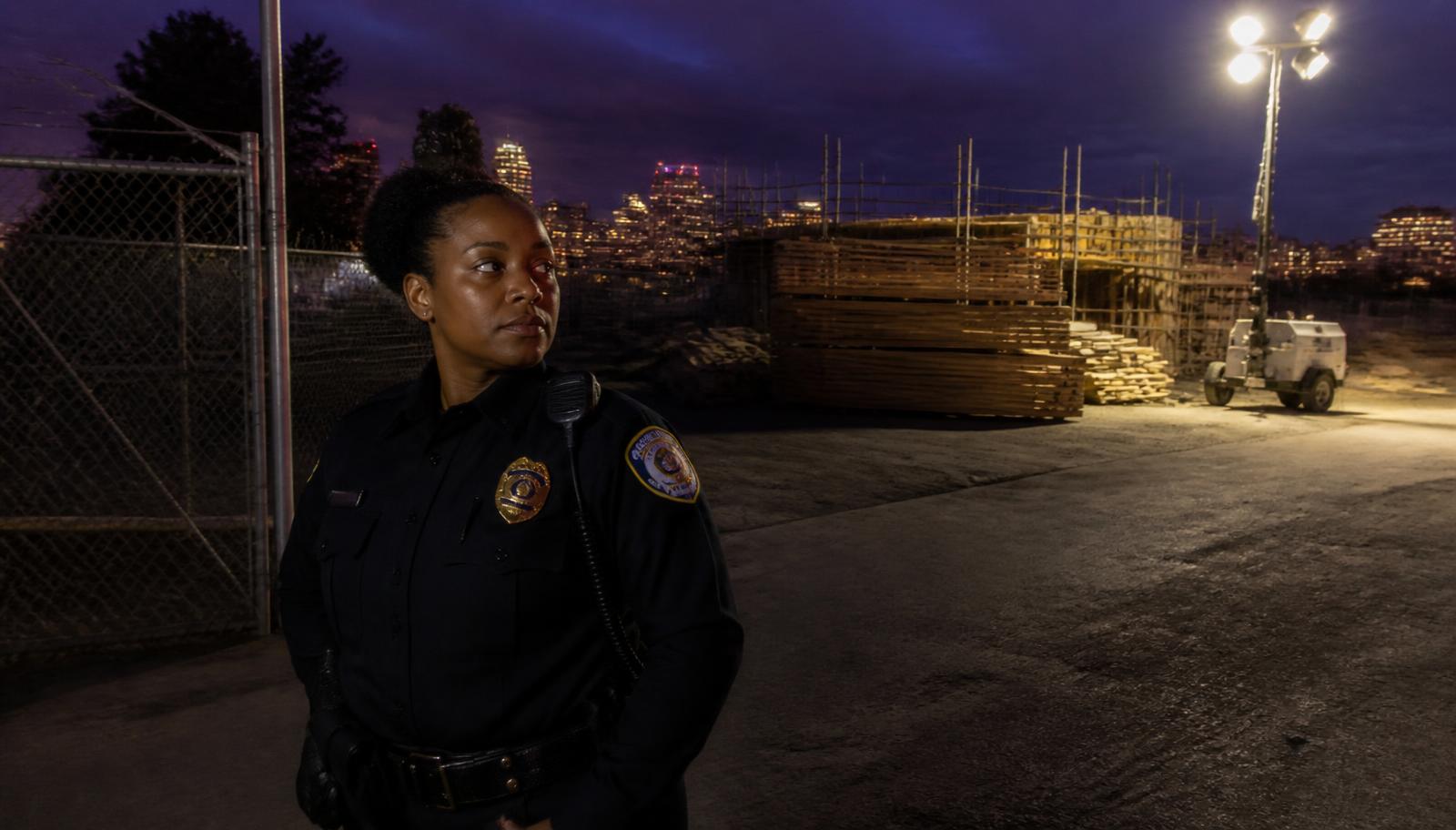
Construction is the clearest cost-benefit case in the region because the loss unit is large and the schedule impact compounds. A stolen generator is not a generator; it is a stolen generator plus a delayed pour plus a rental plus a subcontractor no-show. Copper and tool theft, fuel siphoning, and material walk-offs concentrate in the unattended window and around known delivery dates.
The benchmark for an active vertical site is presence during the entire unoccupied window plus a documented open-and-close. For a graded lot with stored materials, a randomized multi-pass patrol with photo logs of the material stack is often enough. Details are on our construction site security page, and the liability side is covered in safeguard your property from lawsuits.
Retail, restaurant, and hospitality
Here the metric is not incidents; it is staff confidence and closing safety. The benchmark that changes behavior is a visible officer during the last hour of service and the closing walk, plus a documented escort to vehicles. Merchant-privilege detentions are a legal minefield and belong in written post orders reviewed by counsel — see our California case law library for security operations for the framework we train to.
Events
Event staffing is ratio work. Guest count, alcohol, ingress points, and whether the venue requires a licensed PPO all move the number. A single officer at a 300-guest event with alcohol and one entrance is not a security plan; it is a photograph of one. Our event security booking page lists the ratio bands we staff to and the minimum-hour structure.
The reporting standard you should demand
If you take one procurement change away from this report, make it this: buy the documentation, and the coverage follows. A vendor who cannot produce a GPS-verified checkpoint record cannot prove they were there, which means you cannot prove you exercised reasonable care.
Our minimum standard on every account, from a two-pass patrol to a 24/7 post:
- 1.GPS-timestamped checkpoint hits for every pass or tour, exportable as a PDF.
- 2.Daily Activity Report (DAR) filed before the officer goes off shift, with named post, times, and observations.
- 3.Photo-documented exceptions — every open door, damaged fixture, unauthorized vehicle, or occupancy contact gets an image and a time.
- 4.Incident reports within 24 hours, written in factual language suitable for an insurer or a court.
- 5.Monthly rollup with pass counts, exception counts, and a plain-English recommendation list.
- 6.License and insurance file on request — PPO number, guard card status per assigned officer, and certificate of insurance naming you as additional insured where the contract requires it.
What to require in the contract itself
Response window
A number, in minutes, for alarm and callout response — plus what happens when it is missed. "As soon as possible" is not a term.
Post orders
Written, site-specific, and signed. Generic post orders are the single most common cause of an officer doing the wrong thing correctly.
Additional insured
Name the ownership entity and the management company. Confirm limits, not just the existence of a policy.
Supervision ratio
Ask how many posts each field supervisor covers and how often they physically inspect yours. Unsupervised posts drift within weeks.
Turnover policy
Who backfills a callout, how fast, and whether the replacement has read your post orders.
Termination terms
30-day mutual termination is standard. Long lock-ins on unproven coverage are a red flag.
Where technology fits — and where it doesn't
Cameras, license-plate readers, and AI analytics have genuinely changed the economics of perimeter monitoring. They have not replaced the part where somebody has to walk toward the problem. The honest division of labor:
| Capability | Technology wins | Officer wins |
|---|---|---|
| Detection across a wide perimeter | Yes — continuous, cheap per square foot | No — limited to where the officer is |
| Deterrent presence | Partial — signage and visible cameras help | Yes — a marked unit and a uniform change behavior |
| Verification of an alarm | Partial — video reduces false dispatch | Yes — eyes on the actual condition |
| Intervention and de-escalation | No | Yes |
| Evidence quality for prosecution | Yes — recorded footage | Yes — sworn observation plus report |
| Access control with judgment calls | No | Yes |
The cost-effective 2026 pattern for a mid-sized Sacramento property is camera or mobile surveillance coverage on the perimeter, feeding a human who is contractually obligated to respond within a defined window. We laid out the full comparison in physical guards versus AI surveillance.
A 30-day procurement plan
This is the sequence we recommend to every board, GC, and property manager who asks how to do this properly — including when they end up hiring somebody else.
Week 1 — Establish your baseline
Pull your own data before you talk to a vendor. Export the last 12 months of maintenance tickets, police report numbers, insurance claims, and resident or tenant complaints. Map them by location on the parcel and by hour of day. Most sites discover their problem is concentrated in one corner and one four-hour block, which cuts the required spend substantially.
Cross-reference against the City of Sacramento open data portal and county-level tables at OpenJustice to see whether your pattern matches the area or is specific to your property. Property-specific patterns are usually access-control problems and are the cheapest to fix.
Week 2 — Write the specification before the bids
Define the unattended window, the exposure you will accept, the required response time, and the reporting deliverables. Then request bids against that document. Three quotes against one specification are comparable; three quotes against three vendors' own templates are not.
Week 3 — Verify and walk
Check every PPO number at BSIS. Request certificates of insurance and read the limits. Then walk the site at the actual hour of risk — 11pm on a Friday, not 2pm on a Tuesday. Lighting, sightlines, gate behavior, and pedestrian flow look completely different, and any vendor unwilling to do the walk at that hour is telling you something.
Week 4 — Start small, measure, then scale
Contract a 60- to 90-day initial term with defined metrics: exception counts, response times, report timeliness. Review the data at the end of it and adjust the schedule rather than the vendor. Most accounts we run today look nothing like their first month's schedule, because the first month's reports told us where the real exposure was.
Frequently asked, honestly answered
Will a patrol contract lower my insurance premium? Sometimes, and it is worth asking your carrier directly with the documentation package in hand. Carriers respond to demonstrable, documented programs far more than to the existence of a contract. Bring checkpoint records, not a brochure.
Is armed coverage safer? It is different, not automatically safer. Armed coverage raises both capability and liability, and it is appropriate for cash handling, specific threat profiles, and some industrial and pharmaceutical settings. For most HOA and commercial parcels in the region, well-supervised unarmed officers with clear post orders and a real response protocol produce better outcomes at lower risk.
How fast can coverage actually start? For patrol coverage on an existing route, days. For a dedicated post with custom post orders and a specific officer profile, plan on a week to do it properly — and be suspicious of anyone promising a fully staffed 24/7 post tomorrow.
Do cameras let me cut guard hours? Frequently yes, if you shift rather than simply subtract. The usual win is replacing low-value patrol hours with monitored detection, then concentrating officer hours in the window your data flags.
What if my budget only covers the minimum? Then buy the minimum deliberately: pick the highest-risk four-hour block, cover that, document everything, and revisit in 90 days with real numbers. A precisely targeted small program beats a thin sitewide one almost every time.
Sources and further reading
All figures in this report are either arithmetic derived from the stated coverage models or ranges from our own published Sacramento-region service pages. Crime and wage context should be pulled live from the primary sources — they update, and secondhand numbers age badly.
- FBI Crime Data Explorer — agency and offense-level reported crime data
- California DOJ OpenJustice — statewide and county criminal justice datasets
- City of Sacramento Open Data Portal — local police service datasets
- BSIS license verification — PPO and guard card lookup
- BLS OES 33-9032, Security Guards — metro wage data
- California Division of Occupational Safety and Health — fire watch and workplace safety requirements
Internal deep dives: Sacramento security guard services overview, security agency near me, buyer's guides library, fire watch coverage, and the private security encyclopedia.
Get the version of this scoped to your property
We will walk your site at the hour that matters, pull your own 12-month pattern with you, and hand you a written specification you can bid out — to us or to anybody else. There is no charge for the assessment and no obligation attached to it.
Summit Force Security Group, Private Security — PPO #122730, BSIS licensed, headquartered in Sacramento and dispatching across Sacramento County, Placer County, and the Solano corridor. Call 1-800-823-5337 or request a free on-site security assessment and we will bring the numbers.
City-level notes across our dispatch footprint
Coverage design changes with geography. Drive times, parcel size, corridor traffic, and jurisdiction response all shift the correct specification. These are the practical differences we plan around across the footprint.
Sacramento (city and county). The widest range of property types and the tightest drive times, which means patrol packages are efficient here — a single route can carry several accounts without stretching pass intervals. Midtown and downtown parcels are dominated by pedestrian and parking-structure exposure, so foot patrol and structure sweeps outperform vehicle-only passes. Power Inn, Florin-Perkins, and North Sacramento industrial parcels are yard-access problems and reward gate discipline over pass count.
Rancho Cordova. Long commercial frontages along Folsom Boulevard and the Sunrise corridor, plus large light-industrial lots with multiple curb cuts. Multiple entry points make randomized arrival timing matter more than raw pass volume, because a predictable route on a permeable parcel is a published schedule.
Roseville and Rocklin. Heavier retail and mixed-use, with HOA communities that expect board-ready documentation. Closing-hour presence at retail centers and consistent monthly reporting to boards carry more weight here than overnight pass volume.
Folsom and El Dorado Hills. Lower-density, larger parcels, longer drive times between checkpoints. Dwell time per pass matters more than frequency, and site lighting is often the cheapest available improvement before any staffing increase.
Citrus Heights and Antelope. Persistent encampment and transient-activity contacts near commercial rear lots and greenbelt edges. These require written contact protocols and consistent documentation far more than they require an armed posture.
Elk Grove and Laguna. Newer multi-family stock with carport and package-theft patterns concentrated in specific rows and hours. Site-specific data almost always narrows the spend here.
Auburn, Lincoln, and Placer foothills. Longer response distances mean a defined, honest response window in the contract is essential. For remote parcels, camera coverage feeding a contracted response is usually better value than thin patrol frequency.
West Sacramento, Woodland, Davis, Vacaville, and Fairfield. Distribution and agricultural-adjacent facilities with heavy third-party driver traffic. Trailer, seal, and gate logs are the controlling deliverable; without them, loss investigations have nothing to work from.
If your property sits in any of these markets, the assessment starts with your own 12 months of data and the walk at the hour of risk — not with a rate sheet.
Next step
Ready to put officers on post?
- vehicle patrol services in SacramentoMarked units running metro-wide checks, gate sweeps and alarm response.
- local licensed security agencyCalifornia PPO #122730 agency — insured, BSIS-registered, locally owned.
- local security guards on post this weekLicensed officers dispatched from Sacramento HQ with written post orders.
- security patrol services in SacramentoCoverage models, flat hourly rates and what each patrol tier includes.